
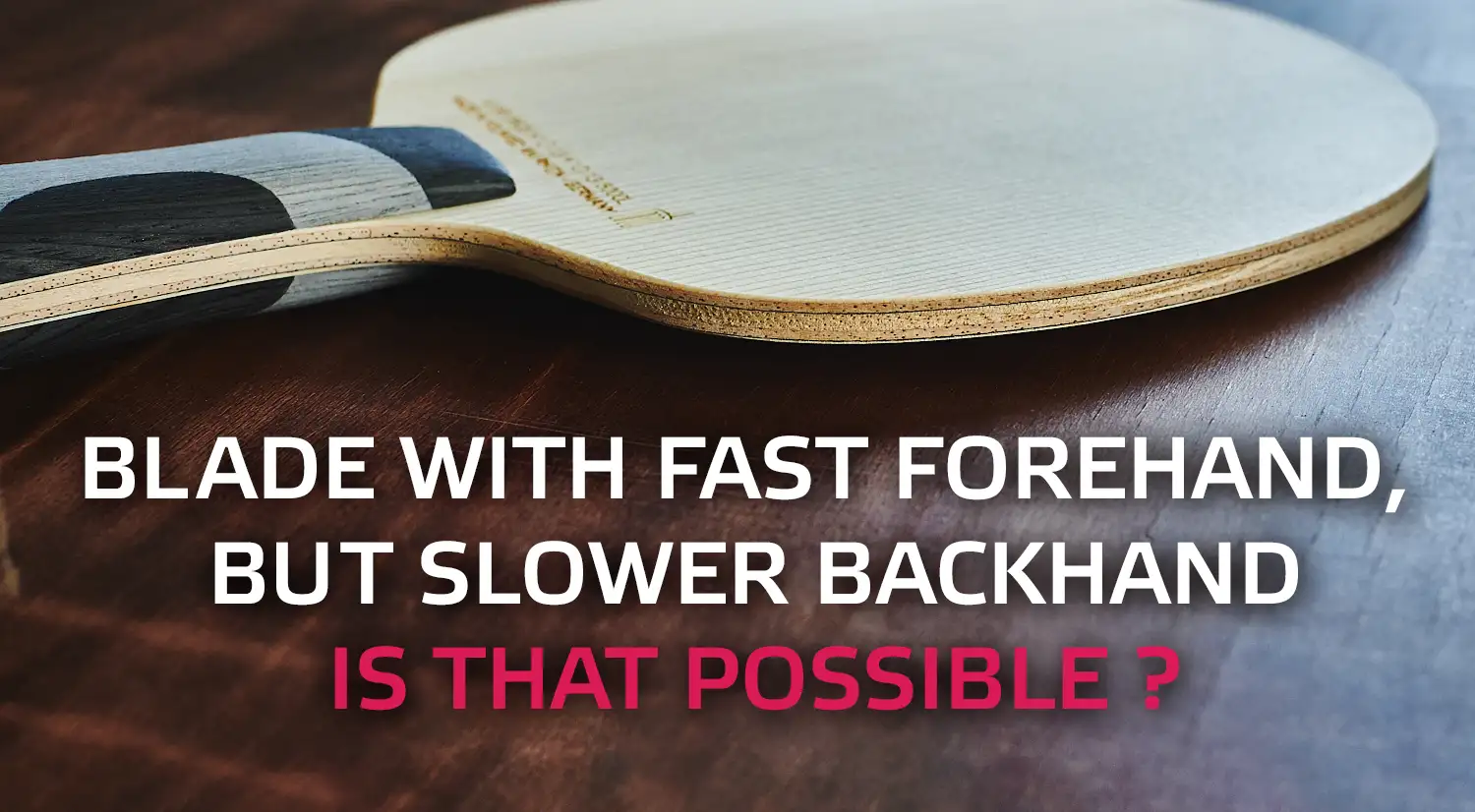
“Can you build a table tennis blade that is faster on the forehand side than on the backhand?”
We get asked this question surprisingly often.
Sometimes it is about having different speeds on the forehand and backhand. In other cases, players are looking for differences in hardness or control: for example, they may want the forehand side to feel harder and more direct, while the backhand offers a little more touch and flexibility – or vice versa.
The short answer is:
There is quite a lot you can change when it comes to the feel of the two sides. When it comes to actual speed, however, things are a little different.
But let’s start from the beginning.
Why have different forehand and backhand sides in the first place?
Not every player uses the same type of rubber or playing style on both sides.
A typical example is someone who uses pimpled rubber on just one side of the blade.
Pimpled rubbers tend to play more precisely on a harder blade than on a softer one. That is why many players prefer a slightly harder and more direct feel on the side where they use their pimples.
In cases like this, an asymmetrical veneer construction can make a lot of sense. You could, for example, make the pimple side slightly harder while keeping more flexibility on the other side.
Exactly what works best always depends on the individual player and their equipment.
Can the forehand really be faster than the backhand?
This is an important point, and the short answer is: no.
Many players imagine that it should be possible to build a blade with, for example, OFF speed on the forehand and a noticeably slower backhand side.
In our experience, unfortunately, that is not really how a table tennis blade works. It would be nice – but it simply isn’t.
When it comes to speed, the blade always works as a complete unit.
The energy generated on ball contact is not determined solely by the outer veneer on the side that hits the ball. The entire blade construction is involved, including the core, intermediate veneers and any composite fibres.
In other words, it is the complete blade construction that determines the overall speed of a table tennis blade.
So unfortunately, we cannot build a blade that is genuinely “faster” on one side and “slower” on the other.
What we can influence very effectively is the way each side feels when the ball makes contact.
For example:
- harder or softer
- stiffer or more flexible
- more direct or more forgiving
- more or less catapult effect
- a different feel when generating spin
And these differences can be very noticeable when you play.
Table tennis blades with different forehand and backhand sides – what are the options?
Option 1: Different veneers on the forehand and backhand
The simplest option is to use different veneers or veneer thicknesses on the two sides of the blade.
Different types of wood vary considerably in hardness, elasticity and overall feel. There is also some flexibility when it comes to the thickness of the individual veneers.
For example, you could use a harder outer veneer on one side and a more flexible veneer on the other.
Harder outer veneers such as Koto or Limba can work particularly well for pimple players. Depending on the feel you are looking for, the opposite side could then be built to offer a little more flexibility.
The important thing is that both sides end up being roughly the same overall thickness. Otherwise, there is a risk of the blade warping.
The result is a blade that feels different on the forehand and backhand sides – although you should not expect a major difference in actual speed.
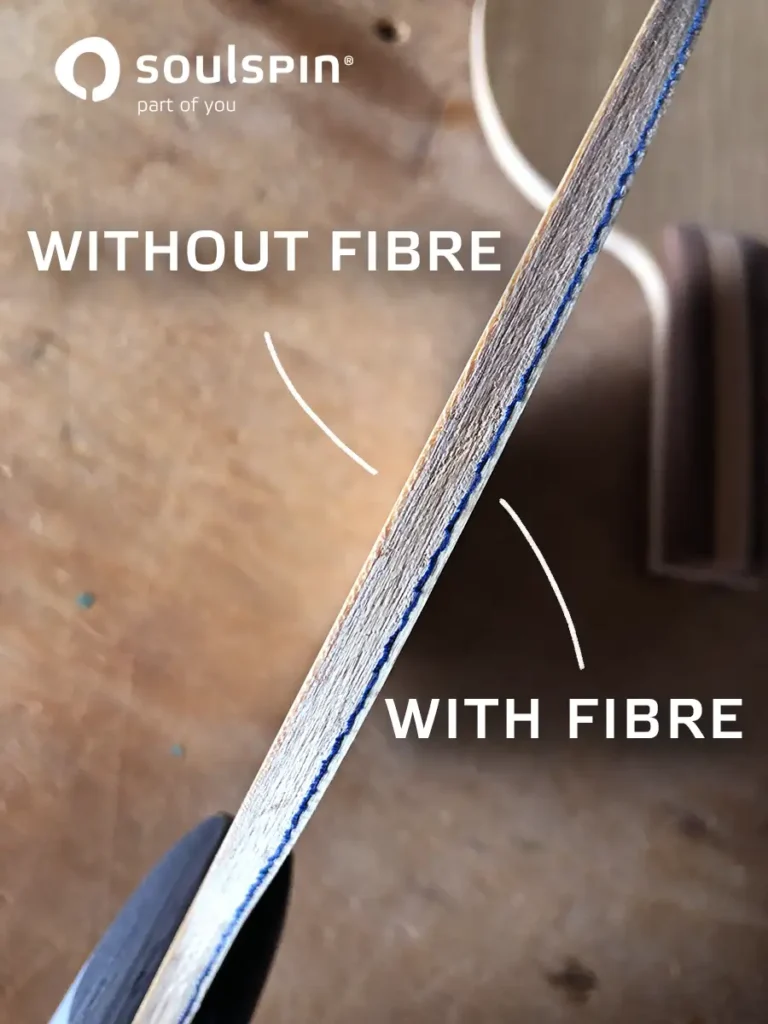
Option 2: Different composite fibre positions – inner vs outer
Things become even more interesting when we are working with carbon or other composite fibres.
It is not only the type of fibre that affects the feel of a blade. Its position within the construction also makes a big difference.
The fibre can be positioned further inside or further outside. We can use a fibre on only one side, or even use completely different fibres on the forehand and backhand.
There are plenty of possibilities.
Here is one example:
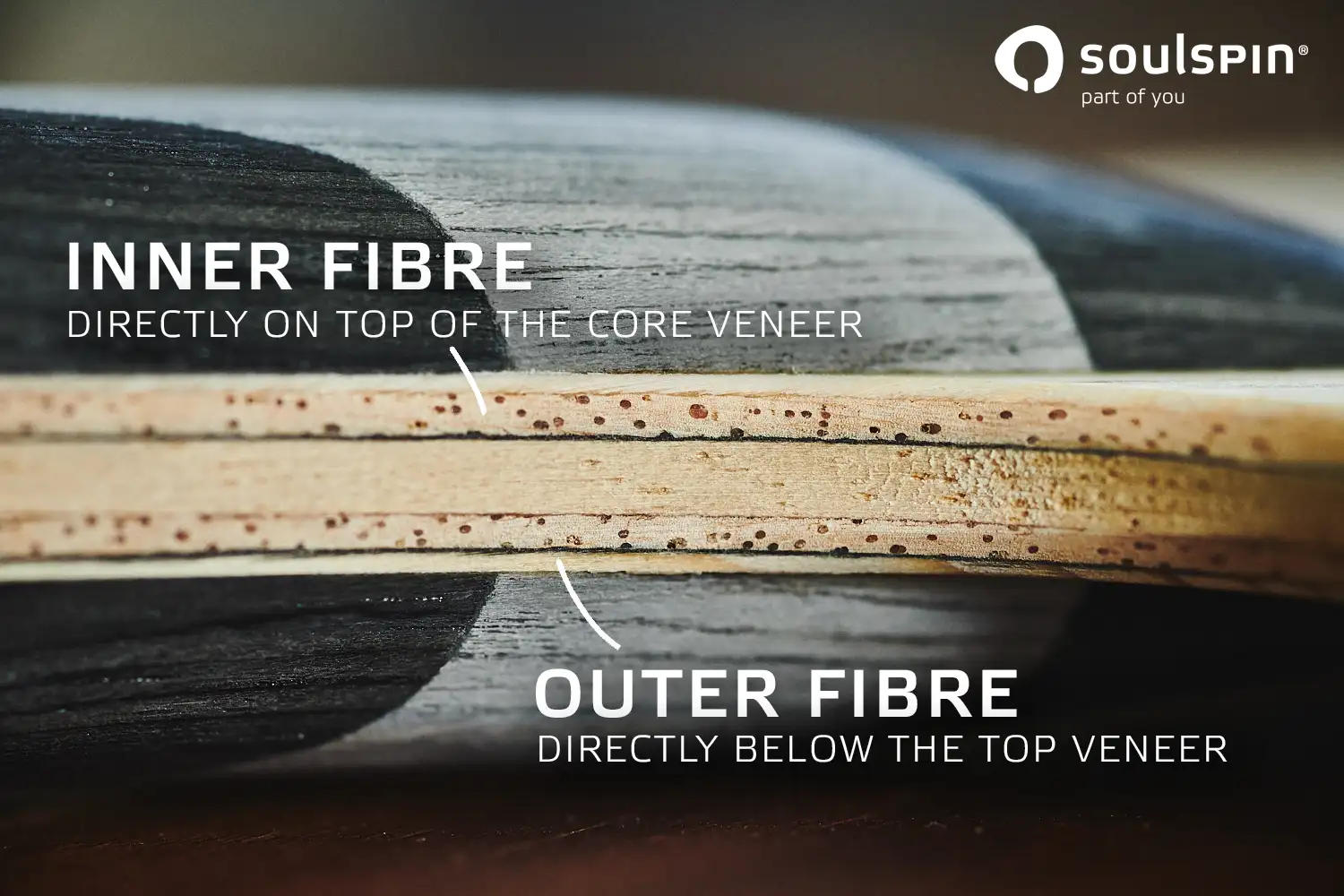
On the forehand side, the composite fibre could be positioned further inside, directly next to the core veneer, with two additional wood veneers above it.
This reduces the influence of the fibre slightly. It does not come through quite as strongly, so the blade feels less stiff and a little more flexible on that side.
On the backhand side, we could position the same fibre further towards the outside, directly underneath the outer veneer.
Here, its effect is much stronger because there is only one layer of wood above the fibre rather than two. Ball contact becomes harder and more direct, and the blade feels noticeably stiffer.
You can clearly feel this difference when playing.
But once again, the same rule applies: you should not expect a major difference in speed between the two sides.
Different forehand and backhand sides: useful or just a gimmick?
That depends entirely on the player.
If you use similar rubbers and play in a similar way on both sides, there is usually no need for an asymmetrical blade construction.
But if you enjoy experimenting with your equipment or use your forehand and backhand in completely different ways, an asymmetrical construction can be very interesting.
We build these types of blades particularly often for players who use inverted rubber on one side and pimpled rubber on the other.
In cases like this, it can make perfect sense to tailor the characteristics of each side of the blade to the respective rubber and to your individual playing style.
How do you design and build a blade like this?
This is where things get a little more complicated.
There are countless possible combinations, so the most important starting point is knowing what you actually want to achieve.
We can work with different types of wood, different veneer thicknesses or different composite fibre positions.
But the right solution always depends on the result you are looking for.
That is why we would not simply say:
“Fast forehand, slow backhand – no problem.”
The much more important question is:
How do you want your forehand and backhand sides to feel, and what exactly are you trying to achieve?
Do you want the backhand to feel harder? More direct? Less flexible?
Do you want more touch and feeling on the forehand?
Once we know that, we can start planning the veneer construction accordingly.
How to order your custom-made blade
If you already know exactly which veneers or blade construction you would like, simply send us your specifications.
Fill in our custom blade enquiry form and we will send you an individual quotation. The enquiry is, of course, completely free of charge.
And if you only know how you would like your blade to play, but have no idea which veneer should go where – that is absolutely fine too.
That is exactly what we are here for, and we will be happy to help.
You can describe what you are looking for in our custom blade enquiry form. We can then work out together which construction could suit your game and your rubbers.
One thing is important to bear in mind: Yes, we can accommodate a wide range of special requests and customise your table tennis blade to suit you.
But everything has to remain within realistic limits.
A miracle blade that combines the best playing characteristics of five completely different blades would be great – but unfortunately, it is simply not realistic.
The same applies to requests such as a blade with four layers of composite fibre that is also supposed to weigh only 70 grams.
Tell us what you have in mind and we will work out together whether – and how – we can make your custom blade a reality.
FAQ – Frequently asked questions about table tennis blades with different forehand and backhand sides
Which players benefit from a table tennis blade with different sides?
We most commonly build these blades for players who use pimpled rubber on one side and want a harder feel on ball contact.
Pimpled rubbers tend to play more accurately and precisely on a blade with a hard outer veneer.
If, for example, you use inverted rubber on the other side and want more spin, we can adjust the blade construction accordingly.
Can you build a table tennis blade that is faster on the forehand and slower on the backhand?
When we build a table tennis blade with two different sides, the main difference is in feel rather than speed.
The speed does not come from the outer veneer alone. The entire blade construction contributes to it, including all of the veneers.
What you can definitely feel, however, is a difference in hardness.
For example, using a hard outer veneer for pimpled rubber on one side and a construction with more catapult effect on the other is perfectly possible.
Can you use different composite fibres on the forehand and backhand?
Yes, absolutely.
For example, you could use a more flexible Basalt fibre on the forehand side and a stiffer carbon fibre on the backhand side.
How much does a table tennis blade with different forehand and backhand sides cost?
That depends on the types of wood and, where applicable, the composite fibres used.
Simply fill in our custom blade enquiry form and we will send you an individual quotation.
The enquiry is, of course, completely free of charge.
Can you predict the weight of a custom-made blade?
Because wood is a natural material, it is very difficult to predict the exact final weight in advance.
We always do our best to meet your weight requirements as closely as possible, but unfortunately we cannot guarantee an exact weight beforehand.
